
Whether you’ve received a complaint or failed an audit, we provide assessments and expert recommendations tailored to your property.

A single ADA parking violation can cost your business thousands of dollars—sometimes tens of thousands—depending on the severity and how long it goes unaddressed. Under the Americans with Disabilities Act, businesses are required to provide accessible parking for customers and employees with disabilities. Fail to meet those requirements, and you’re not just risking fines. You’re also creating barriers that prevent real people from accessing your business.
The tricky part? Many of the most common violations aren’t obvious at first glance. Faded paint, a slope that’s just a fraction too steep, or signage mounted a few inches too low can all put you out of compliance. And in most cases, these issues develop gradually—meaning business owners don’t notice them until someone else does.
The good news is that most ADA parking violations are straightforward to fix once you know what to look for. This guide walks you through the five most common issues found in parking lots across the country, explains what the ADA requires, and outlines how to bring your property back into compliance.

Why ADA Compliance in Parking Lots Matters
The Americans with Disabilities Act, signed into law in 1990, sets clear standards for accessible design across public and commercial spaces—including parking lots. Title III of the ADA applies to places of public accommodation, which covers most businesses open to the public. This means retail stores, restaurants, medical offices, and countless other facilities are legally obligated to meet ADA parking requirements.
Complaints can be filed with the Department of Justice, and private lawsuits are also permitted under the ADA. Civil penalties for first-time violations can reach $75,000, with subsequent violations running up to $150,000. Beyond legal exposure, non-compliance signals to customers with disabilities that your business wasn’t designed with them in mind—and that reputation is hard to recover from.
Regular parking lot audits are one of the most effective ways to catch problems early. Let’s look at what those audits should cover.
1. Incorrect ADA Signage Height
ADA signage is one of the most frequently cited violations, and it’s often one of the easiest to overlook. The ADA Standards for Accessible Design require that accessible parking signs display the International Symbol of Accessibility and be mounted so that the bottom of the sign is at least 60 inches above the ground. Signs that are mounted too low—or absent entirely—immediately put a property out of compliance.
Van-accessible spaces have an additional requirement: they must include a secondary “Van Accessible” sign beneath the standard accessibility symbol. Without it, drivers of modified vans may be unable to identify the appropriate space.
How to fix it: Inspect every accessible space in your parking lot. Measure the height of each sign from the ground to the bottom of the sign face, and confirm that van-accessible spaces have the correct secondary signage. Replacing or repositioning signs is typically a low-cost fix, but it must be done correctly to satisfy ADA requirements.
2. Narrow Access Aisles
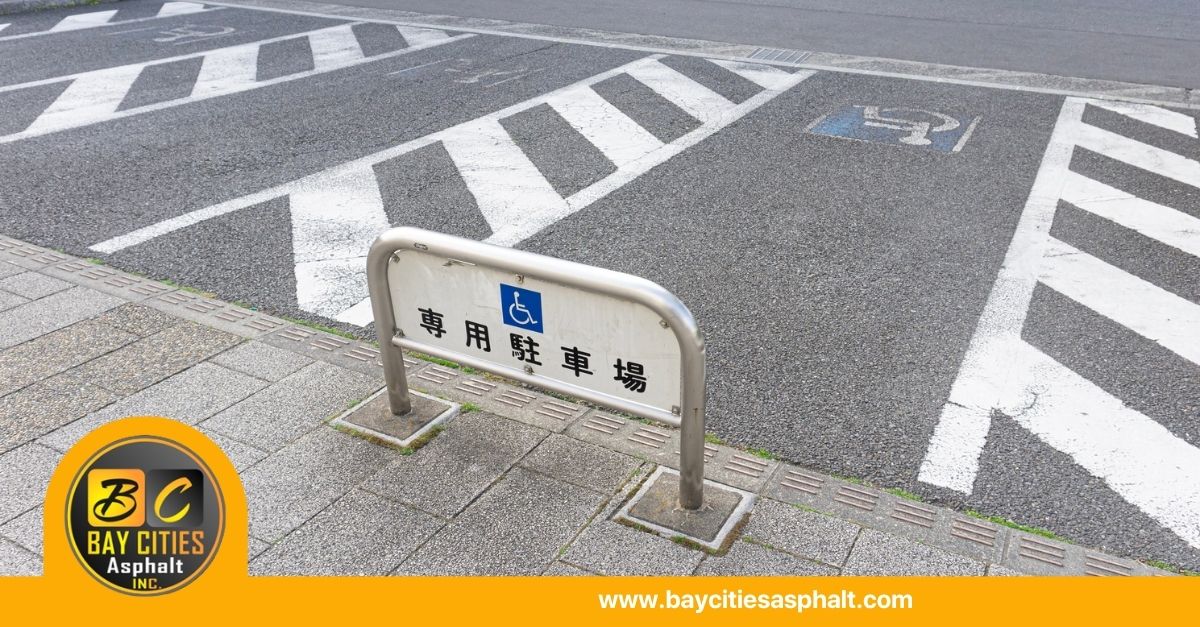
Access aisles are the striped areas adjacent to accessible parking spaces that allow wheelchair users to safely exit and enter their vehicles. These aren’t decorative—they serve a critical functional purpose. Standard accessible spaces require an access aisle that is at least 60 inches wide. Van-accessible spaces require a minimum of 96 inches.
Aisle widths that fall short of these measurements are among the most common violations found during ADA audits. Sometimes the issue is poor original design. More often, it’s the result of re-striping jobs that didn’t account for ADA requirements, or parking lot reconfigurations that shifted space layouts without revisiting compliance.
How to fix it: Measure your access aisles carefully. If they’re too narrow, the lot may need to be re-striped or reconfigured to bring them into compliance. This is typically a job for a professional paving and striping company that understands ADA layout standards.
3. Improper Slope
Accessible parking spaces and their access aisles must be as level as possible. The ADA specifies a maximum slope of 1:48 in any direction—which works out to roughly a 2% grade. Slopes steeper than that make it difficult or dangerous for wheelchair users to transfer in and out of vehicles, particularly on sloped driveways or hillside lots.
Slope violations are often invisible to the naked eye. A surface can appear flat while still exceeding the allowable grade, which is why measuring with a digital level or hiring a professional to conduct a slope analysis is so important.
How to fix it: If your accessible spaces have a slope issue, resurfacing or regrading the affected area is usually required. In some cases, this may mean milling and repaving a section of the lot. It’s also worth addressing during any broader asphalt maintenance project to keep costs manageable.
4. Worn or Faded Striping
Parking lot striping fades over time due to sun exposure, weather, and general wear. Faded markings are a compliance issue because accessible spaces—including the access aisles and the boundary lines—must be clearly visible. If a customer or inspector can’t identify the accessible space, legally it may as well not exist.
Worn striping is one of the most common violations because it develops gradually. Business owners often don’t notice until the paint is almost completely gone.
How to fix it: Re-stripe your accessible spaces using traffic-grade paint that meets ADA color and visibility standards. The International Symbol of Accessibility must be painted on the surface of each space, in addition to signage. Many businesses schedule re-striping as part of routine parking lot maintenance every few years to stay ahead of this issue.
5. Missing Van-Accessible Spaces
The ADA requires that a certain portion of accessible parking spaces be van-accessible. Specifically, for every six accessible spaces (or fraction thereof), at least one must be van-accessible. A parking lot with only standard accessible spaces—but no van-accessible designation—is out of compliance, regardless of how well-maintained everything else is.
Van-accessible spaces must meet stricter dimensional requirements, including a wider access aisle (96 inches), or an 8-foot-wide space with a 5-foot access aisle on both sides. Overhead clearance along the vehicle route to the space must also be at least 98 inches.
How to fix it: Audit your accessible parking layout against the required ratio. If van-accessible spaces are missing or incorrectly designated, your lot will need to be reconfigured. A paving contractor familiar with ADA compliance can help determine the most efficient way to update the layout without a full redesign.
How Bay Cities Asphalt Can Help
At Bay Cities Asphalt, we’ve helped businesses throughout the Napa, CA area and beyond navigate ADA upgrades that keep their properties in compliance. From re-striping and regrading to full parking lot resurfacing, our team understands what it takes to meet ADA standards and protect your business from liability.
Take ADA Compliance Off Your Worry List
ADA parking violations rarely fix themselves—and the longer they go unaddressed, the greater the legal and financial risk. The five issues covered here represent the most common problems we see in parking lots, but they’re also among the most fixable.
A professional audit is the best place to start. Once you know exactly where your lot stands, you can prioritize repairs and build a compliance plan that protects your business for years to come.
Ready to get started? Contact Bay Cities Asphalt today for a parking lot assessment and let’s make sure your property is built for everyone.