
You are sitting in a budget meeting, reviewing the line items for property maintenance. The quote for crack sealing the parking lot is staring up at you. It’s only $500, but the budget is tight this quarter. The cracks don’t look that bad—just a few spiderwebs here and there. Surely, it can wait until next year?
This is the most common and expensive mistake property managers and owners make.
It is easy to view asphalt maintenance as purely cosmetic. We assume that if the parking lot looks black and smooth, it’s healthy, and if it’s gray with a few cracks, it’s just “aging.” However, asphalt management is an economic equation, not an aesthetic one. That $500 preventive repair isn’t about making the lot look pretty; it is about preventing a $50,000 structural failure down the road.
Understanding the true lifecycle of your pavement is the only way to protect your ROI. Here is why ignoring those small fissures is the quickest way to drain your capital reserve.
The “Cosmetic” Misconception
When we see a crack in a wall or a chipped tile, it usually stays that way. It doesn’t actively destroy the rest of the house. Asphalt is different. It is a flexible pavement, designed to move and carry loads. When that surface breaks, it stops acting as a shield and starts acting as a funnel.
Many property owners in Solano and Contra Costa Counties treat crack sealing like painting a room—something you do to freshen things up. In reality, crack sealing is more akin to fixing a leak in your roof. You wouldn’t ignore a leak because the water stain “isn’t that big yet.” You fix it because you know the water is rotting the beams behind the drywall.
The Mechanics of Failure: How Water Kills Asphalt
To understand the ROI of maintenance, you have to understand the enemy: water.
Asphalt consists of rock, sand, and liquid asphalt cement (the binder/glue). Over time, the sun oxidizes this binder, causing it to become brittle and gray. As the flexibility leaves the pavement, traffic loads cause it to crack.
Once a crack opens—even a hairline fracture—water begins to infiltrate.
- Intrusion: Rainwater seeps through the crack and settles into the sub-base (the gravel and soil foundation beneath the asphalt).
- Erosion: The water softens the sub-base. When heavy vehicles drive over this wet, soft spot, the foundation shifts and pumps out.
- Void Creation: With the support gone, the asphalt layer above bridges a gap. It can no longer support the weight of traffic.
- Alligatoring: The asphalt collapses into the void, creating a pattern that looks like an alligator’s back. This is structural failure.
At this stage, you cannot seal the crack. You must cut out the damaged section, repair the base, and repave the area with hot mix asphalt. The cost difference between these two interventions is astronomical.
The Math: Pennies vs. Dollars
Let’s look at the financial reality of deferred maintenance.
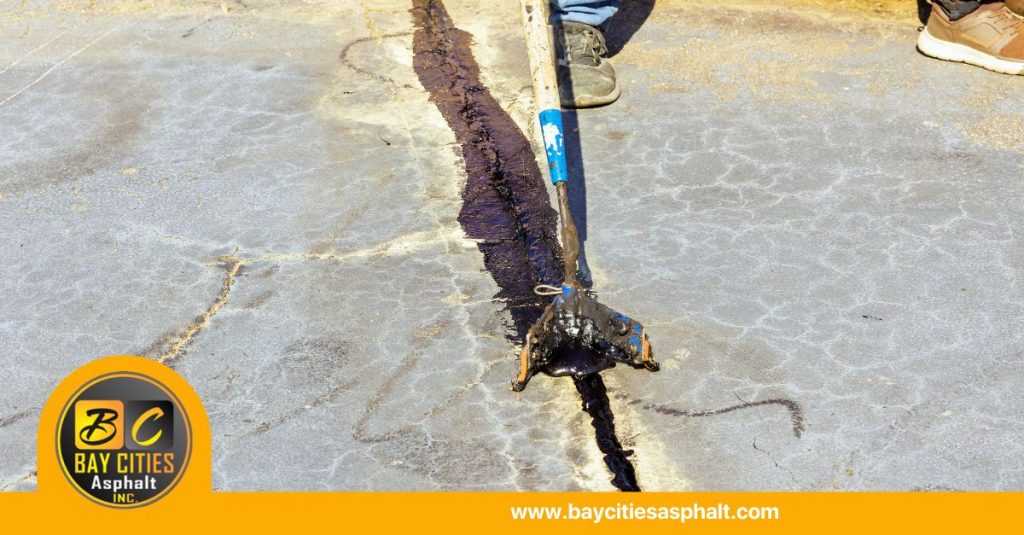
If you catch the issue early, Crack Sealing typically costs pennies per linear foot. A specialized rubberized sealant is applied to the crack to prevent water intrusion. This stops the erosion cycle in its tracks.
If you wait until the sub-base fails, you are looking at Remove and Replace (R&R). This involves mobilization of heavy machinery, demolition, hauling away debris, importing new base rock, and laying new hot asphalt. This costs dollars per square foot.
The industry rule of thumb often cited is that every $1 spent on pavement preservation early in the life of the asphalt saves $6 to $10 in rehabilitation costs later.
Consider the “Pavement Condition Index” (PCI). Pavement deteriorates on a curve. It stays in relatively good condition (PCI 75-100) for about 75% of its life. During this time, maintenance is cheap. Once it hits a certain age without maintenance, the quality drops off a cliff. If you wait until the pavement is visually “bad,” you have likely missed the window for cheap repairs and have entered the zone of expensive rehabilitation.
Liability and Safety Hazards
Beyond the direct construction costs, deferred maintenance creates immediate liabilities.
Commercial property owners in litigious environments know that trip hazards are a massive risk. A neglected crack eventually widens or heaves, creating an uneven surface. If a tenant or customer trips and falls, the resulting lawsuit will likely dwarf the cost of the original repair.
Furthermore, severe potholes and rutting can damage vehicles, leading to further claims against the property management or HOA. Keeping the surface smooth and sealed is the first line of defense against premises liability claims.
Why Local Expertise Matters
The environment plays a massive role in how fast your asphalt degrades. While we don’t deal with the severe freeze-thaw cycles of the Midwest, the Bay Area and surrounding counties have their own challenges. The intense UV exposure in Santa Clara and Sonoma dries out asphalt binder quickly, accelerating brittleness. The rainy seasons in Northern California then exploit those brittle cracks.
At Bay Cities Asphalt, we understand the specific soil conditions and climate stressors of our service areas. Whether your property is in the clay-heavy soils of Contra Costa or the vineyards of Sonoma, the maintenance plan needs to be tailored to local conditions to maximize the lifespan of the paved surface.
Steps to Protect Your Asset
You don’t need to be a paving expert to save money. You just need a proactive plan.
1. Regular Walks
Walk your property every six months. Don’t just look at it from a moving car. Look for graying color (oxidation) and hairline cracks.
2. Sealcoating
Sealcoating acts as sunblock for your pavement. It replenishes the fines and creates a barrier against UV rays, oil, and water. A regular sealcoat schedule (every 3-5 years) keeps the asphalt flexible.
3. Immediate Crack Sealing
If you see a crack wider than a quarter-inch, fill it. Do not wait for the next major paving project. The water is not waiting, and neither should you.
Your Parking Lot is an Investment
It is easy to look at a parking lot as just a slab of black rock. But for an HOA, a shopping center, or an office park, it is one of the most expensive assets on the books.
A $500 crack repair bill is not a nuisance; it is an insurance policy. It guarantees that you won’t be writing a check for a full reconstruction five years early. By shifting the mindset from “fixing what’s broken” to “maintaining what’s good,” you protect your capital and ensure your property remains safe, accessible, and valuable.
Don’t let a small fissure become a massive financial crater. Contact Bay Cities Asphalt today to assess the current health of your pavement.